
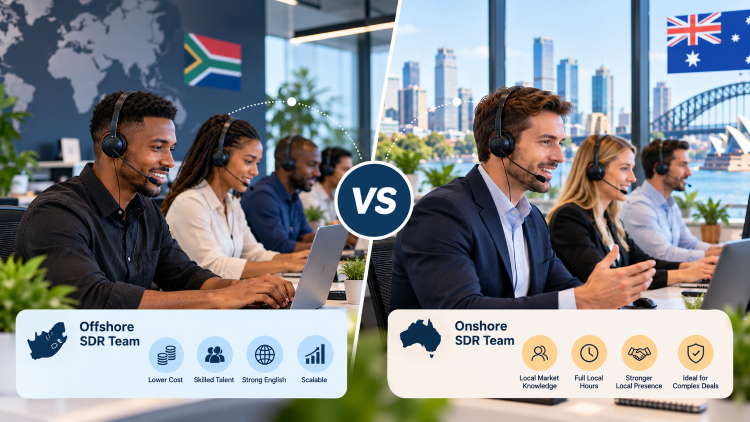
For the Australian market, an offshore SDR team, such as J2’s South Africa-based teams, typically costs materially less than an onshore Australian team, and on a well-run program the quality gap is far smaller than most buyers expect. Onshore earns its premium where deep local market knowledge, full same-hours coverage, or complex enterprise deals decide the outcome. The right choice in the local vs offshore sales question comes down to your buyers, your deal complexity, and how much local presence your market expects.
Is an offshore SDR team cheaper than onshore?
Yes, and the gap is significant. A South African SDR generally costs materially less than an equivalent Australian rep for the same role. Two things drive that: lower local wages and a favourable exchange rate against the Australian dollar. On rep cost alone, close to two offshore reps for the price of one local hire, which changes how quickly you can test a new market or scale coverage. This post compares the models rather than listing absolute prices, so the figures here are relative rather than dollar retainers.
One caveat keeps the comparison honest. That percentage is the saving on the rep itself. A managed program on either side still carries targeting, tooling, coaching and management, so your total saving is real but sits below the headline labour figure.
Do offshore SDRs work for the Australian market?
For most outbound motions, yes. South Africa is one of the stronger offshore destinations for English-speaking markets, for specific reasons:
- English is an official language and the main language of business, and many South African professionals speak it as a first language.
- Accents are widely regarded as neutral and easy to follow for Australian, UK and US listeners, which matters on cold calls where comprehension drives connection and conversion.
- Written English is equally strong, so email and LinkedIn sequences read naturally to Australian buyers.
- The talent pool is well educated and adapts quickly to international sales processes and CRM tools.
Quality on outbound is decided less by location than by the system around the rep: targeting, messaging, call coaching and quality assurance. A managed South-Africa-based offshore SDR team with that structure will usually outperform an unmanaged local hire left to work alone.
Time Zones and Coverage
This is the real operational difference, and it favours onshore. South Africa runs on GMT+2, so the natural overlap with Australia is the South African morning against the Australian afternoon. To cover a full Australian business day, managed offshore teams run shifted hours rather than relying on that window alone. An onshore Australian SDR team covers local hours natively, with no shift roster and immediate availability for same-day callbacks and meetings. If your buyers expect a call returned within the hour across the whole working day, that native coverage carries real weight.
In practice this is a scheduling question rather than a barrier. A managed provider sets the roster to your priority calling windows and tracks connect rates by time slot, so coverage is planned rather than left to chance.
When Should You Choose Onshore?
Choose an onshore team when local nuance or presence is central to the sale:
- Complex or enterprise deals where the rep must read local market context and hold a credible senior conversation.
- Regulated or relationship-heavy sectors where buyers expect a local voice.
- Brand-sensitive outreach to senior Australian decision-makers, where shared context builds rapport faster.
- Situations that need full same-hours coverage without a shifted roster.
Choose offshore when cost efficiency and scale matter most, the offer is clear enough to qualify at volume, and either the overlap window or a shifted roster covers your calling times.
Many teams settle on a hybrid: an onshore SDR on strategic or enterprise accounts where local rapport matters, and an offshore team on volume prospecting where efficiency wins. That split captures most of the cost saving while keeping a local voice on the deals that need one.
Making the Call
Location is not the quality lever. The lever is whether the reps sit inside a real outbound system, with targeting, coaching and management around them. Because J2 Group runs both an onshore Australian SDR team and a South-Africa-based offshore team from our Melbourne base, we scope the model to your market and deal profile rather than defaulting to one. If you want that mapped to your buyers and calling windows, a short scoping call is the fastest way to a clear recommendation.