
A managed SDR program is an outsourced sales development function where a provider gives you a dedicated SDR, or a small team, plus the tools, process and day-to-day management to run your outbound and deliver qualified meetings into your calendar. You keep control of strategy and messaging. The provider carries recruitment, training, tooling, coaching, quality assurance and reporting. In short, you get an operating function, not just a person in a seat.
What a managed SDR provider handles
A managed SDR program has two layers. The first is the outbound work itself:
- defining your Ideal Customer Profile and building verified target lists,
- multi-channel outreach across phone, email and LinkedIn,
- qualifying replies against an agreed standard,
- booking sales-ready meetings straight into your calendar.
The second layer is the operating system around the rep: recruitment and training, the tech stack, call coaching, quality assurance, and structured reporting with regular reviews. This second layer is what separates a managed program from simply adding a headcount. The provider owns the machine, you own the strategy and the closing.
That reporting layer is not an afterthought. A managed program should give you live visibility into activity and results, usually through a shared dashboard and a weekly review, so you always know what is working and where the pipeline is coming from.
How is it different from hiring an SDR?
When you hire an SDR, you get one person, and everything around them is your job: recruiting, onboarding, tooling, coaching, target-setting and performance management. If that person leaves, the function leaves with them.
A managed SDR program gives you the rep, the system and the management from day one, with a single point of accountability for whether qualified meetings actually appear. Whether building or buying is the right call for your business is a separate decision, driven by cost, ramp and how much sales management capacity you already have. This guide is about what the model is, not which to choose.
Managed program vs pay-per-appointment
The two are often confused. A pay-per-appointment or lead-list service is paid for volume and usually works from a shared pool of reps across many clients, so meeting quality can be uneven and the follow-up is left to you. A managed SDR program gives you dedicated reps who act as an extension of your team, judged on qualified meetings and on what the reporting can prove. The accountability sits in a different place.
Who it is for
A managed SDR program tends to fit B2B teams that need pipeline quickly but do not have the capacity, or the appetite, to build and manage an outbound team from scratch. It suits founders and lean sales teams, businesses testing a new market without committing to headcount, and teams whose leaders should not be spending their week managing SDR activity. It is a particularly strong fit when there is no experienced SDR manager in the business to run the function properly.
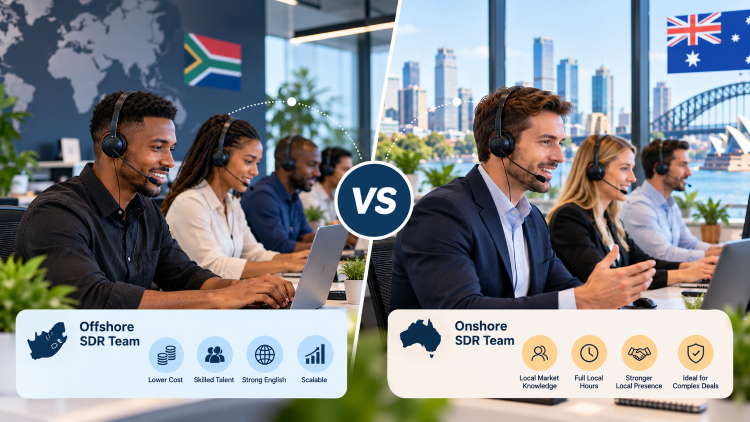
At J2 Group, the model runs as managed programs from our Melbourne base: a managed Australian SDR Program and a South-Africa-based offshore SDR team, each deployed and managed end-to-end. If you want to see how the model would map to your market, a short conversation is the fastest way to a clear answer.
Frequently asked questions
Is a managed SDR program the same as SDR as a service?
In practice, yes. “Managed SDR program”, “SDR as a service” and “outsourced sales development” describe the same model: a provider that runs your sales development as a dedicated, managed function rather than selling you a list or a tool. The label changes, the substance does not.
Is a managed SDR program the same as AI SDR software?
No. Software sells you automation, but you still supply the strategy, data, copy and the people to run it and read the replies. A managed SDR program is the operated function, with real people and a manager accountable for the result. Software can support a program, it does not replace one.
Are the SDRs dedicated to my business or shared across clients?
In a true managed SDR program the reps are dedicated to your accounts and work as an extension of your team. That is the main difference from a pooled, pay-per-meeting service where reps are split across many clients and quality is harder to control.