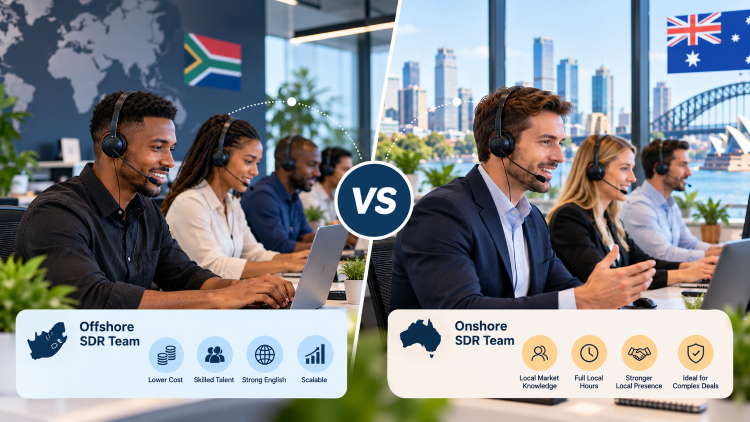

The default assumption in Australian B2B sales has always been that your SDR sits in the same city as your customers, your product team, and your account executives. That assumption is being quietly dismantled by a growing number of businesses who are scaling pipeline through remote sales reps without the overhead that comes with local hiring.
The shift is happening for practical reasons. Rising SDR salary costs, a shallow local talent pool, and first-year attrition rates that regularly exceed 30 percent have made the traditional model harder to justify. Remote and managed SDR programmes are filling that gap, and the pipeline results are holding up.
Why Australian B2B Businesses Are Rethinking Local-Only Sales Teams
The fully loaded cost of a local SDR in an Australian capital city has risen materially over the past three years. Base salaries for entry-level SDR roles in Sydney and Melbourne now typically sit between $65,000 and $80,000 before super. Add recruitment fees, onboarding time, technology, and the management bandwidth required to ramp a new hire, and you are looking at a first-year cost of $110,000 to $180,000 before the role has generated a single qualified meeting.
That cost structure is manageable when the local talent pool is strong and attrition is low. In practice, neither condition reliably holds. First-year SDR attrition in Australia sits at 30 to 40 percent across the market, driven by a combination of poor hiring, inadequate onboarding, and a candidate pool that treats SDR roles as a short-term stepping stone rather than a career path. The businesses that are shifting to remote SDR models are not abandoning local hiring because they prefer it theoretically. They are responding to a cost and talent problem that local hiring is not solving.
The post-pandemic normalisation of remote work removed the operational friction that previously made offshore and remote SDR models difficult to run. CRM integration, prospecting platforms, communication tools, and asynchronous reporting dashboards now make it straightforward to manage a remote sales rep with the same visibility and accountability as someone sitting in your office. It is a shift J2 Group has seen play out directly through our managed SDR programmes with Australian B2B businesses. The infrastructure argument against remote SDR teams no longer holds.
The Real Cost Difference: Remote Sales Reps vs. Hiring Locally
The cost differential between a local in-house SDR and a remote or managed SDR model is not simply a wage gap. It is a structural overhead gap. The table below breaks down where the difference actually lies.
| Cost Component | Local In-House SDR | Remote/Managed SDR |
| Base salary + super | $75,000-$95,000 | Significantly lower |
| Recruitment fees | $8,000-$15,000 | Included in provider fee |
| Technology stack | $5,000-$12,000/yr | Included or shared |
| Onboarding time | 4-6 weeks unproductive | 2-3 weeks, frameworks pre-built |
| Management overhead | High, fully internal | Shared with provider |
| Failed hire risk | $110k-$180k all-in | Materially reduced |
The saving in base remuneration is real but it is not the most significant factor. The more material difference is in the elimination of recruitment risk, onboarding overhead, and management burden. A failed local SDR hire costs between $110,000 and $180,000 all-in. A remote SDR model that does not perform can be restructured or exited without the same sunk cost.
It is also worth being direct about what remote sales reps scaling pipeline does not mean in this context. It is not a race to the bottom on quality. Businesses that approach offshore SDR hiring as a cost-cutting exercise rather than a capability question typically get cost-cutting results. The model works when the talent is genuinely strong, the onboarding is structured, and the performance management is consistent. Those conditions can be met remotely. They just require the same rigour that strong local hiring demands.
How Quality Is Maintained Across Remote SDR Teams
The most common objection to remote SDR models from Australian B2B leaders is a quality concern: will a remote rep understand our market, represent our brand credibly, and produce outreach that does not sound generic or disengaged?
It is a fair question and the answer depends entirely on how the model is set up. The businesses that struggle with remote SDR quality are almost always the ones that treated the hiring decision as a cost play and underinvested in onboarding and coaching. The businesses that get strong results from remote sales reps treat the model with the same operational discipline they would apply to any high-performing sales function.
Structured onboarding is the foundation. A remote SDR who spends their first two weeks in deep immersion on the client’s ICP, competitive landscape, messaging framework, and objection handling has the same contextual foundation as a local hire who has been through the same process. The geography is irrelevant to the depth of that understanding.
Ongoing coaching is what sustains quality over time. Call recording and review, weekly performance cadences, messaging iteration based on prospect feedback, and regular calibration between the SDR and the client-side team are the mechanisms that keep remote outreach sharp. These are not remote-specific requirements. They are what good SDR management looks like regardless of where the rep is based.
Scripted personalisation frameworks address the concern about generic outreach. A remote SDR working within a well-constructed framework that defines how to research a prospect, how to personalise the opening line, and how to connect the outreach to the prospect’s specific business context will produce better outreach than a local hire running on instinct with no structure.
Access to a Wider Talent Pool
Beyond cost, the talent access argument for remote SDR hiring is one that Australian B2B leaders underweight. The local SDR candidate market in Australia is competitive, shallow, and heavily concentrated in Sydney and Melbourne. For businesses operating outside major capitals, or in niche industries where sector-specific communication skills matter, local SDR recruitment is a genuine constraint.
Remote and offshore SDR models open the candidate pool to regions with strong English-language B2B sales capability, professional work cultures that align with Australian business norms, and timezone overlap that makes real-time collaboration practical. The Philippines, for example, has a well-established outsourced sales function industry with a workforce trained in B2B outbound sales, comfortable with Australian business culture, and operating in hours that overlap with east coast Australia.
For businesses that have struggled to find strong SDR candidates locally, the shift to a remote model is not just a cost decision. It is a talent access decision. More options means faster hiring, better fit, and shorter ramp-up. In a function where ramp time directly determines when pipeline starts flowing, the compounding effect of better candidate selection is material.
How Remote SDR Models Work in Practice
Understanding the operational reality of a remote SDR model matters as much as understanding the commercial case for it. The businesses that run remote SDR programmes effectively have a clear structure for lead assignment, outreach management, performance reporting, and client collaboration. Those that struggle typically lack one or more of these components.
Lead assignment and outreach management in a remote SDR model operates through the client’s CRM, typically Salesforce or HubSpot. Prospect lists are built and assigned within the CRM, sequences are run through a tool like Outreach, Salesloft, or Apollo, and all activity is logged in real time. The client has full visibility into outreach volume, response rates, and pipeline activity without needing to be in the same building as the rep.
Reporting structures for remote SDR teams need to be more formalised than for in-house teams precisely because the informal visibility of a shared office does not exist. Weekly reporting cadences covering outreach volume, connect rate, meetings booked, and pipeline value generated give the client-side team the data needed to make decisions without micromanaging the rep’s daily activity.
The distinction between independently hiring a remote SDR and engaging a managed SDR provider is worth understanding clearly. A business that hires a remote SDR independently takes on responsibility for sourcing, onboarding, tooling, coaching, and performance management. The cost saving is real but the operational burden is significant, particularly for businesses without a dedicated SDR manager. A managed SDR provider handles the full cycle: candidate vetting, onboarding infrastructure, ongoing coaching, and transparent reporting. The trade-off is less direct control over the individual rep in exchange for faster deployment and lower management overhead.
J2 Group’s managed SDR service operates on this model. The SDR is pre-vetted and trained before the first outreach, sequences and ICP documentation are built collaboratively with the client, and performance reporting is structured from day one. Businesses that want the commercial benefits of remote sales reps scaling pipeline without building the management infrastructure themselves use this model to get to market faster with lower operational risk.
The Metrics That Matter When Managing a Remote Sales Team
Managing a remote SDR without a clear measurement framework is where most programmes lose accountability. Call volume is the metric most businesses default to because it is easy to track. It is also the least useful indicator of commercial performance in a B2B outbound context.
The metrics that drive real accountability in a remote SDR programme are the ones connected to pipeline quality, not just activity quantity. The table below defines the core measurement framework.
| Metric | What It Measures | Healthy Benchmark | Red Flag |
| Outreach volume | Activity level | 60-80 touches/day | Below 40 consistently |
| Connect rate | Outreach effectiveness | 8-15% on cold calls | Below 5% |
| Meeting booked rate | Conversion from conversation | 20-35% of connects | Below 15% |
| Qualified meeting rate | Pipeline quality | 70%+ of booked meetings | Below 50% |
| Pipeline value generated | Commercial output | Defined by ACV and target | Not being tracked |
Qualified meeting rate deserves particular attention because it is the metric most directly connected to pipeline value. A remote SDR booking fifteen meetings per month where twelve are with decision-makers who match the ICP is generating more commercial value than a rep booking twenty-five meetings where the majority are with people who cannot buy. Tracking qualified meeting rate forces both the SDR and the client to stay honest about whether the outreach is targeting the right people in the right way.
Performance benchmarks for remote SDRs should be set in stages that reflect ramp reality. Weeks one and two are onboarding. Weeks three and four are initial outreach with high coaching intensity. Weeks five through eight are where activity benchmarks should begin applying. Measuring a remote SDR against full performance benchmarks before week five produces bad data and damages the working relationship before the rep has had a genuine opportunity to ramp.
Transparent reporting is non-negotiable. Businesses managing remote SDR teams without real-time access to activity and pipeline data are operating on trust rather than information. That is not a sustainable basis for commercial accountability. Any remote SDR model worth engaging should be able to provide dashboard-level visibility into performance from week one.
Is a Remote SDR Model Right for Your Business?
Remote sales reps scaling pipeline is not the right answer for every Australian B2B business. The model works best under specific conditions and can underperform in others. Being clear about which category your business falls into before committing to a remote SDR model saves significant time and money.
The conditions under which a remote SDR model delivers strong results:
- You have a defined ICP and a repeatable outbound process that can be documented and transferred to a remote rep.
- You need to scale the pipeline faster than local hiring timelines allow.
- You have tried local SDR hiring and found the cost-to-outcome ratio unsatisfactory.
- You are in a regional market or niche industry where local SDR talent is genuinely scarce.
- You have the capacity to provide clear messaging direction and timely feedback on leads, even if you do not have bandwidth to manage the SDR day-to-day.
The conditions under which a remote SDR model is likely to underperform:
- Your value proposition is still being defined and the messaging is not yet stable enough to transfer to someone outside your business.
- Your sales process requires deep in-person relationship-building at early stages that a remote outreach function cannot support.
- You do not have the internal capacity or appetite to review leads, provide feedback, or approve messaging in a structured cadence.
- You are approaching the model primarily as a cost-cutting exercise without genuine commitment to the quality conditions that make it work.
The honest summary is this: a remote SDR model is a capability decision, not just a cost decision. The businesses that treat it as the former and build the operational conditions to support it generate real pipelines. The businesses that treat it as the latter typically get what they paid for.
For Australian B2B businesses that want the commercial upside of remote sales reps without the complexity of building the infrastructure themselves, J2 Group’s managed SDR service is built specifically for this use case. The model combines pre-vetted remote talent, structured onboarding, ICP-driven outreach, and transparent performance reporting under a single engagement. You can review how this has performed for businesses at different stages of growth on the J2 Group case studies page, or get in touch to discuss whether the model fits your current situation.
Frequently Asked Questions
What is a remote sales development rep and how do they work?
A remote SDR is a sales development representative who operates outside the client’s physical office, managing outbound prospecting, lead qualification, and meeting booking via phone, email, and LinkedIn. They integrate with the client’s CRM and reporting systems and operate within a structured outreach framework defined either by the business or by the managed SDR provider. The client has full visibility into activity and pipeline output without the SDR needing to be on-site.
How much can Australian businesses save by switching to a remote SDR model?
The savings are not just in lower base remuneration, though that gap is real. The more significant saving comes from eliminating recruitment risk, reducing onboarding overhead, and removing the management burden that falls on internal teams with a local hire. A failed local SDR hire costs between $110,000 and $180,000 all-in. A remote SDR model that does not perform can be restructured without the same sunk cost exposure.
How do you manage quality control with a remote sales team?
The key mechanisms are structured onboarding with brand and messaging immersion, regular coaching sessions tied to call recording and review, transparent reporting dashboards with real-time activity data, and defined escalation paths for qualified leads. Businesses that run remote SDR models without these mechanisms in place tend to have quality problems. Businesses that build them in from the start generally do not.
Can remote SDRs represent an Australian business as credibly as a local hire?
Yes, when the onboarding and coaching infrastructure is in place. Communication quality and personalisation ability are the real credibility markers in outbound sales, not physical proximity. A remote SDR who has been through deep brand immersion, understands the ICP, and works within a structured personalisation framework will produce outreach that is indistinguishable in quality from a local hire who has been through the same preparation.
What is the difference between outsourcing SDRs and using a managed SDR provider?
An outsourced or freelance SDR typically requires the business to manage training, tooling, reporting, and process independently. The cost may be lower but the operational burden sits with the client. A managed SDR provider handles the full cycle including candidate vetting, onboarding, ongoing coaching, and performance reporting within a structured engagement. The distinction matters because most of the quality and accountability problems associated with remote SDR models stem from treating managed SDR work as a simple outsourcing exercise rather than a structured programme with defined operating standards.